Water heater leaking from the bottom in Mount Pleasant, TX
A puddle under your water heater is never normal. Here are the causes we find in Mount Pleasant, TX homes, how to trace the leak in ten minutes, and when the tank has reached the end of its life.
Summary: A water heater leaking from the bottom almost always means one of six things, from a corroded tank to a weeping relief valve — and the location of the puddle tells you which one you are dealing with. This guide walks through each cause, how to check it yourself, and the repair-or-replace decision, with the local context that matters.
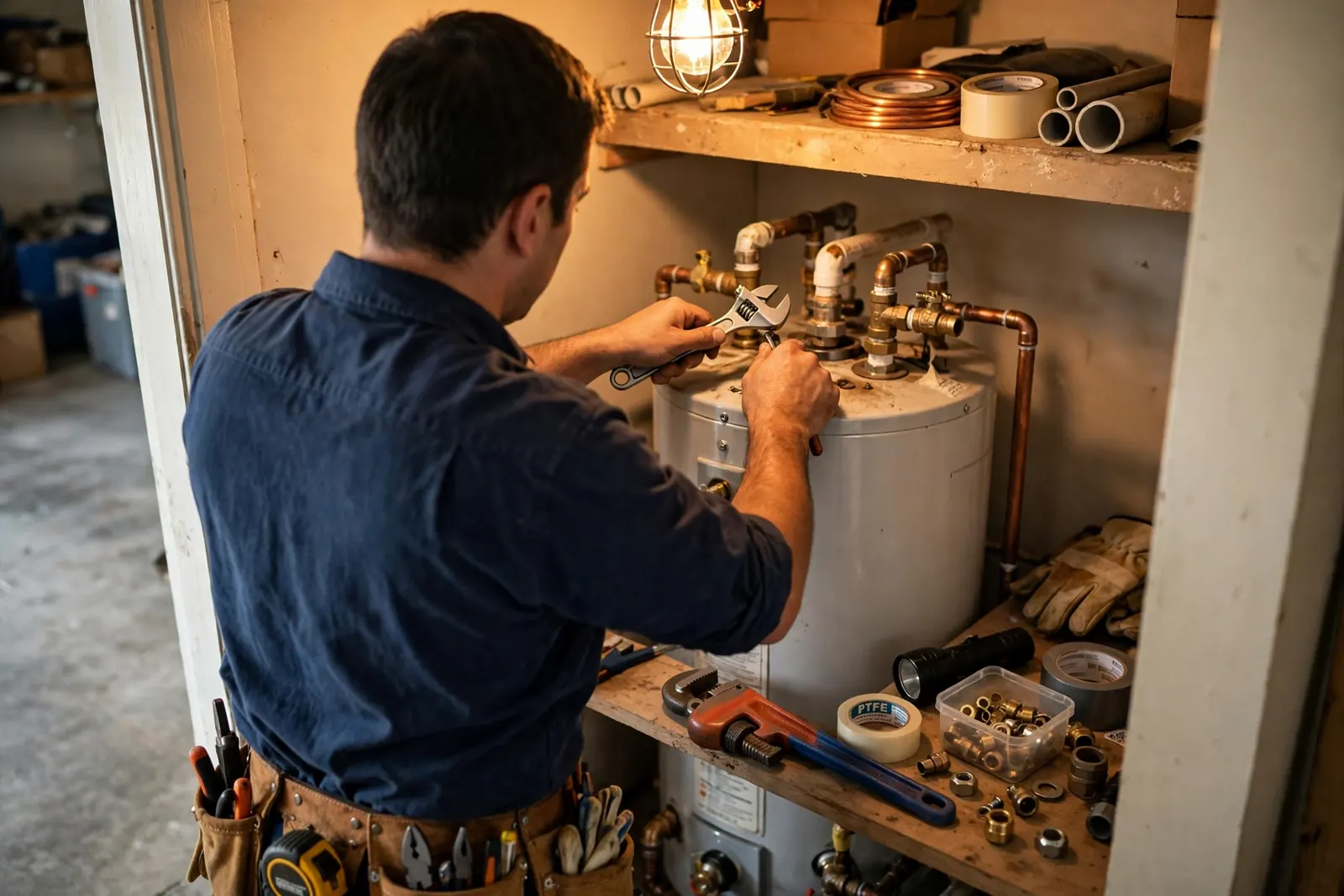
A water heater leaking from the bottom almost always means one of six things: the tank itself has corroded through, the drain valve is loose or cracked, the temperature-and-pressure relief valve is weeping, a fitting above the tank is dripping down the shell, the gas valve area is leaking, or the tank is sweating condensation. The location of the puddle tells you which one you are dealing with, and only one of the six means the tank is finished.
We are NTP Plumbing, and we trace these leaks across Mount Pleasant, TX every week. Below we walk through each cause, how to check it yourself, and the repair-or-replace decision — with the local context that matters, from the age of the housing stock to the permit rules that apply when a heater is replaced.
Water heater leaking from the bottom: the short answer on six places
Finding the source comes first. A leak at the bottom of the unit is one of six things, and only a corroded tank means replacement is the only real option.
- Tank corrosion — the steel shell has rusted through from the inside. Not repairable.
- Drain valve — the spigot at the base is loose, cross-threaded, or has a worn washer. Usually a straightforward fix.
- T&P relief valve — the safety valve is stuck open or weeping. Replaceable.
- Inlet and outlet fittings — the connections on top are leaking and water runs down the side. Fixable.
- Condensation — a cold tank in a humid garage sweats. Not a leak at all.
- Gas valve or pilot assembly — water pooling near the burner compartment from a failed gasket on a gas unit.
Why tanks corrode in Mount Pleasant, TX homes
Inside every tank is a glass-lined steel shell and a sacrificial anode rod. The anode rod absorbs corrosive elements so the steel does not. Once the anode is used up, the lining starts to pit, and rust-through at the bottom seam is what you eventually see on the floor.
Age is the main driver here. Mount Pleasant, TX has a median home build year of 1978, with more than half of homes built before 1980, so many water heaters in town are serving older homes with older plumbing around them. A tank that is past ten years old and leaking from the shell has simply reached the end of its service life. No published hardness figure exists for Mount Pleasant, TX water, so we test your water first rather than blaming a number — sediment still settles in every tank over time, and flushing it out during maintenance is what keeps the bottom of the tank from overheating and corroding faster.
How to tell where the leak is coming from
You can narrow the source in about ten minutes with a flashlight and a dry towel. Here is the sequence we use on every call.
- Shut off the power or gas. Flip the breaker for an electric unit. Turn the gas valve to pilot or off for a gas unit.
- Dry the floor and the tank. A towel around the base shows you where water reappears first.
- Look at the top fittings. Mineral crust or staining at the connections means the leak is up top, running down.
- Check the T&P valve and overflow pipe. Water in the pipe means the valve is passing.
- Inspect the drain valve. A drip at the spigot is the valve, not the tank.
- Look at the tank seam. Rust streaks running down the shell to the base mean the tank is gone.
If you cannot tell, call us. We use leak detection in Mount Pleasant, TX equipment to confirm the source before any work is agreed.
Repair or replace? What makes the call
Repair wins when the leak is a valve or fitting and the tank is under eight years old. Replace wins when the tank itself is leaking, the unit is over ten years old, or you are facing a second repair in two years.
- Under 6 years old, valve or fitting leak: repair.
- 6 to 10 years old, tank leak: replace.
- Over 10 years old, any leak: replace.
- Any age, rust-coloured hot water or popping sounds: replace.
If the tank is leaking, a patch is not a repair. It is a delay. The metal is thin and the next leak is usually close behind. If you are replacing, this is also the moment to weigh a tankless unit against another tank — our comparison of tankless vs tank water heaters for Mount Pleasant, TX homes walks through the trade-offs without pushing either one.
Permits and code for a water heater replacement
Replacing a water heater in Mount Pleasant, TX is plumbing work that requires a permit from the City of Mount Pleasant, TX — it is not on the state list of permit-exempt jobs, which covers repairing leaks and replacing faucets, fill valves, garbage disposals, and water closets. Work follows the 2024 International Plumbing Code adopted by the City of Mount Pleasant, TX under Ordinance 2026-2, effective 20 January 2026, and permits are handled when required. The City's own rules also set access dimensions for a water heater in an attic — a passageway at least 30 inches high by 22 inches wide, solid flooring, and a level service space — so an attic unit needs clear access before it can be swapped. Work done without a permit costs double the permit fee under the City's rules, so the permit is part of doing the job properly, not an optional extra.
Common mistakes we see homeowners make
The most expensive mistake is ignoring a slow bottom leak for a month. A tank that drips steadily puts hundreds of gallons into your floor, subfloor, and drywall over a few weeks. We have seen a drain-valve fix turn into a floor replacement because the homeowner waited.
- Putting a bucket under it and calling it fixed. The leak is still running, and the tank is still failing.
- Using tape or epoxy on a tank seam. It holds briefly at best and hides the real problem.
- Turning the temperature up to compensate. Higher temperature speeds up corrosion and raises the scald risk.
- Skipping the anode rod. Checking and replacing the anode rod on schedule is the cheapest way to extend tank life.
- Skipping the drain pan. Where a leak would cause damage, the code calls for a pan under the heater — it is cheap insurance for the floor below.
If you are also seeing rusty water at the taps or a leak elsewhere in the house, tell us when you call. Our leak repair service in Mount Pleasant, TX covers the rest of the system too, and we would rather fix both in one visit than have you call back next week. Homes in Southgate and downtown Mount Pleasant, TX often have the oldest tanks in town, because the housing there dates to the 1940s through the 1970s — if your heater is original to a house of that era, it is long past its service life.
When to call a professional
Call a professional the moment you see water at the base of the tank and cannot identify the source in ten minutes. A bottom leak on a gas unit is also a safety issue — water near the burner can damage the gas valve. On an electric unit, water near the wiring is a shock risk, so shut it off at the breaker first.
Our team handles emergency plumbing in Mount Pleasant, TX for active leaks. We shut off the water, find the source, and tell you straight whether it is a repair or a replacement. If you are replacing, we also handle water heater installation in Mount Pleasant, TX for new construction and additions.
Get help with plumbing in Mount Pleasant, TX
If your water heater is leaking from the bottom, find the source first, shut off the power or gas, and do not let a slow leak run for weeks. Call NTP Plumbing at (903) 350-9085 — open 24 hours, Monday–Sunday.