For homes and rentals
Most home calls start with a stain, a bill, or water where it should not be. We find the line, repair it, and test it before we leave.
- Supply line under a sink
- Slab leak in a hallway
- Frozen line in the attic
Pipe repair is the professional fixing of a damaged or leaking water or drain pipe in a Mount Pleasant, TX home. A leaking pipe in Mount Pleasant, TX does not wait for business hours, and neither do we. NTP Plumbing is open 24 hours, Monday through Sunday. We find the failed section, repair it to the 2024 International Plumbing Code adopted by the city, and pressure-test the line before we leave.
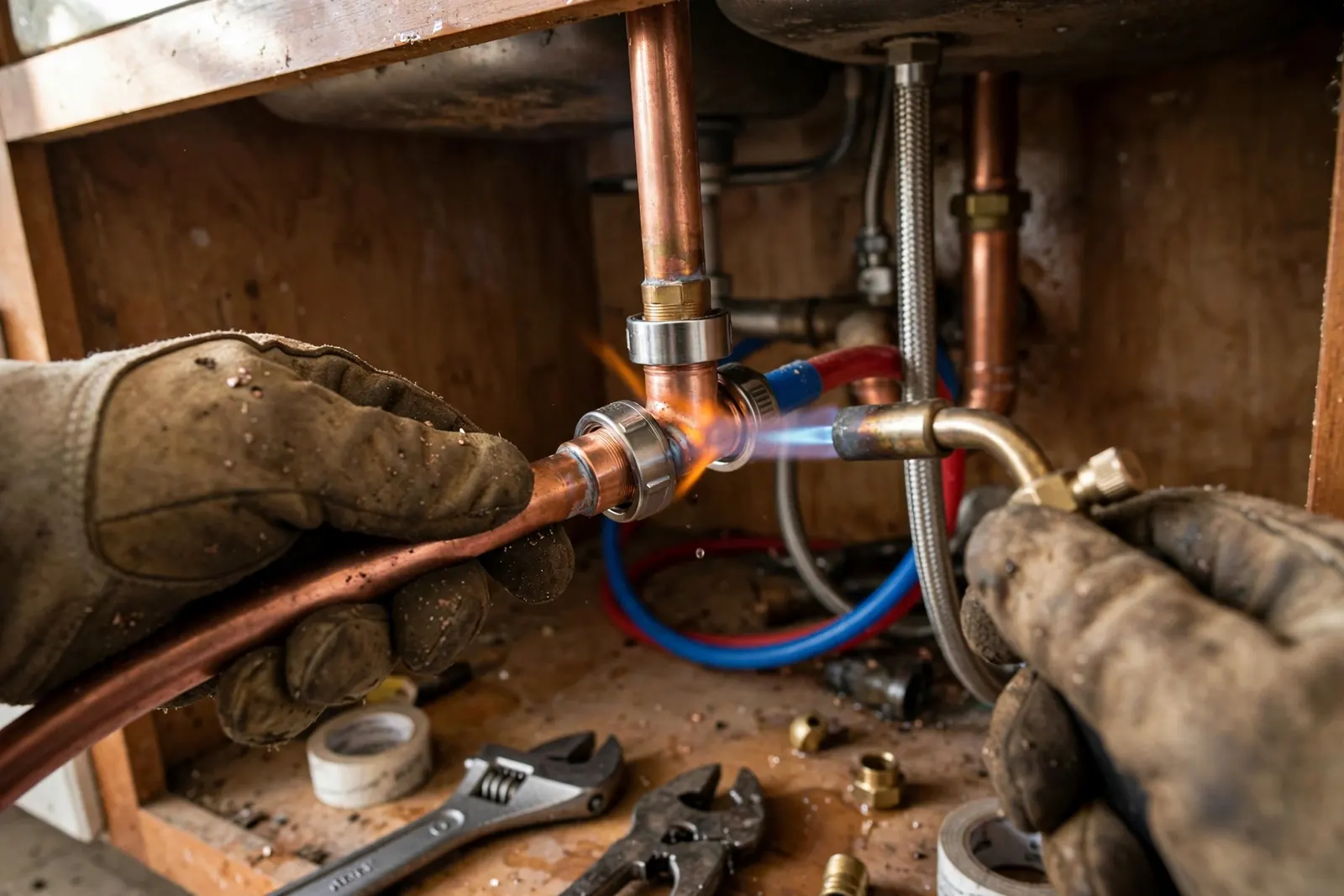 Shutoff checkPressure testLeak located
Every pipe repair call includes the diagnosis, the repair itself, and a pressure test before we leave. What changes from job to job is access and material, so we quote those after we see the line. Here is what you can count on being part of the job.
We use a pressure gauge, acoustic listening gear, and a camera where needed to find the exact failure point. You get the location and the cause explained before any cutting starts.
The damaged pipe comes out and a new section goes in with the correct method for the material: soldered copper, crimped PEX, or solvent-welded PVC. Fittings and solder are part of the job.
We bring the line back to full pressure and watch the gauge before closing anything up. If a joint weeps, we redo it on the spot before closing anything up.
While the water is off, we check the shutoff valves on that line. A valve that will not close all the way turns the next repair into a flood, so we flag it and quote a replacement if needed.
Old pipe and debris leave with us, and the work area gets wiped down. You get photos of the repair before it was covered, which is useful if you ever sell the house.
A home and a rental get the same repair — the failed section is cut out and the line is tested at pressure. What changes is the access, the schedule, and who needs the paperwork.
Most home calls start with a stain, a bill, or water where it should not be. We find the line, repair it, and test it before we leave.
A leak in a rental costs money every hour it runs. We coordinate access with the tenant, repair the line, and document the work for your file.
A plain-language look at what Pipe Repair involves and when it is needed. The City of Mount Pleasant charges a $75 residential plumbing permit fee where a permit is required (inside city limits) — that is a City fee, not our price.
See how it worksMost calls start the same way: a water bill that jumped, a damp spot on the slab, or water pooling at the base of a wall. East Texas clay swells when wet and shrinks when dry, and that movement stresses buried lines. In older homes around Downtown Mount Pleasant, TX, galvanised supply pipe from the 1940s–1960s era and cast-iron drains are still in service and corrode from the inside out.
Newer homes are mostly PEX and PVC, which fail differently — a crimp ring lets go or a fitting cracks at a freeze point. With roughly 50–60 freezing nights a year, January and February keep attic and crawlspace lines at risk. Whatever the material, we isolate the line, cut out only the failed section, and prove the repair holds pressure before anything is closed back in.
Find the exact failure first, repair it to code, and prove it holds pressure before anything gets closed in.
Five steps, from the first phone call to the final pressure test. You will know what is happening at each one.
You call (903) 350-9085 and describe what you see: where the water is, how fast it is coming, whether the shutoff holds. We talk you through killing the water at the main if you have not already. A tech is dispatched with the right parts for copper, PEX, or PVC on the truck.
On site we walk the system, check the pressure gauge, and use a leak detection microphone or sewer camera to pin down the exact break. Most residential lines are located on the first visit. You get the location and the repair options before we cut anything.
We shut the line down, drain it, and cut out the damaged section with a pipe cutter. The new section goes in with the right method for the material: soldered copper, crimped PEX, or solvent-welded PVC.
Before anything gets closed back in, we bring the line up to full pressure and watch it. A repair that holds at full pressure is a repair we will stand behind. If it weeps, we redo the joint on the spot, not on a return trip.
We haul out the old pipe, wipe down the work area, and walk you through what failed and why. You get photos of the repair before it was covered, plus a note on which other lines in the house are worth watching. Payment is due when the work is done.
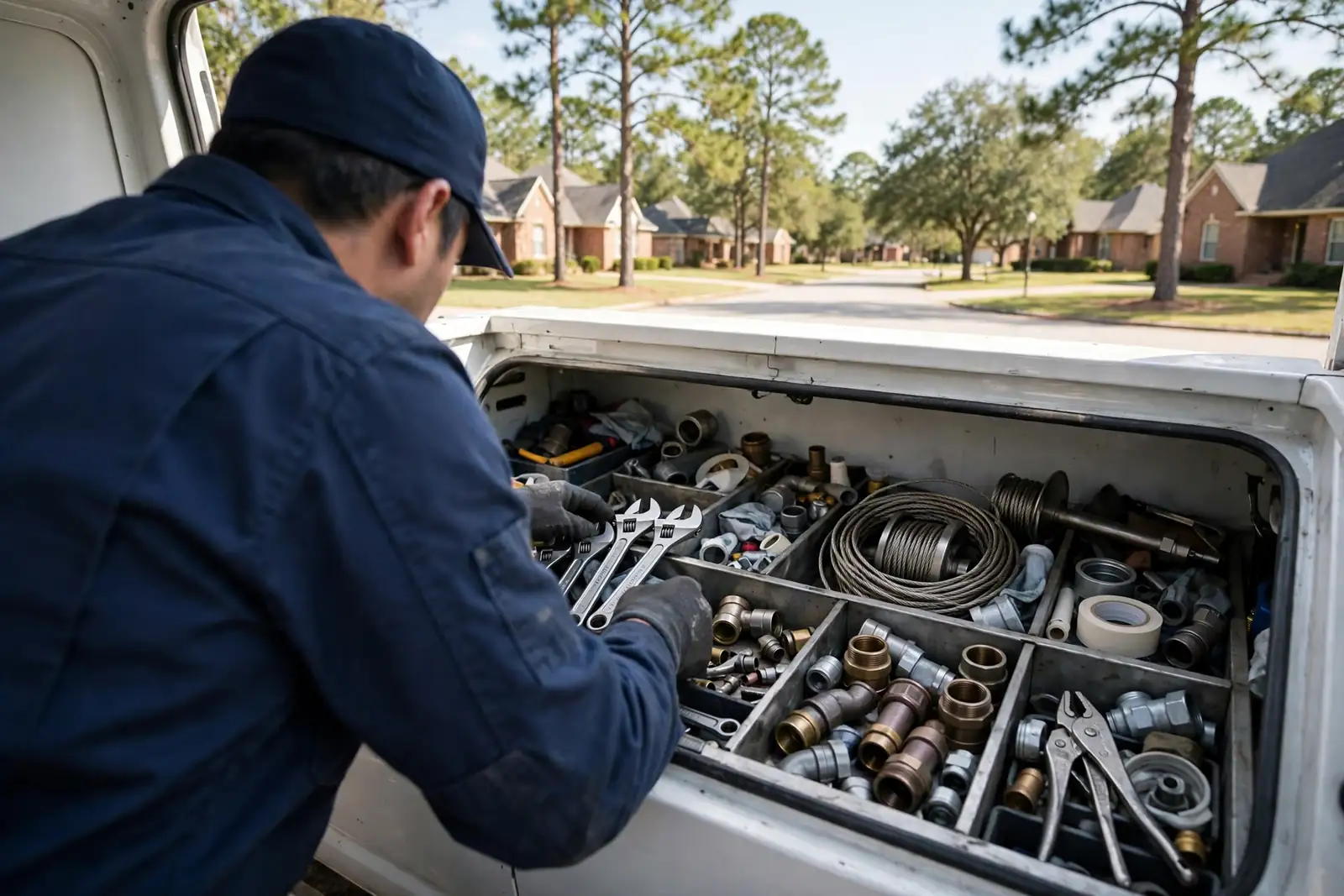
Move across a circle, or focus it and press Enter, for an illustrative thermal view of this pipe repair photograph.
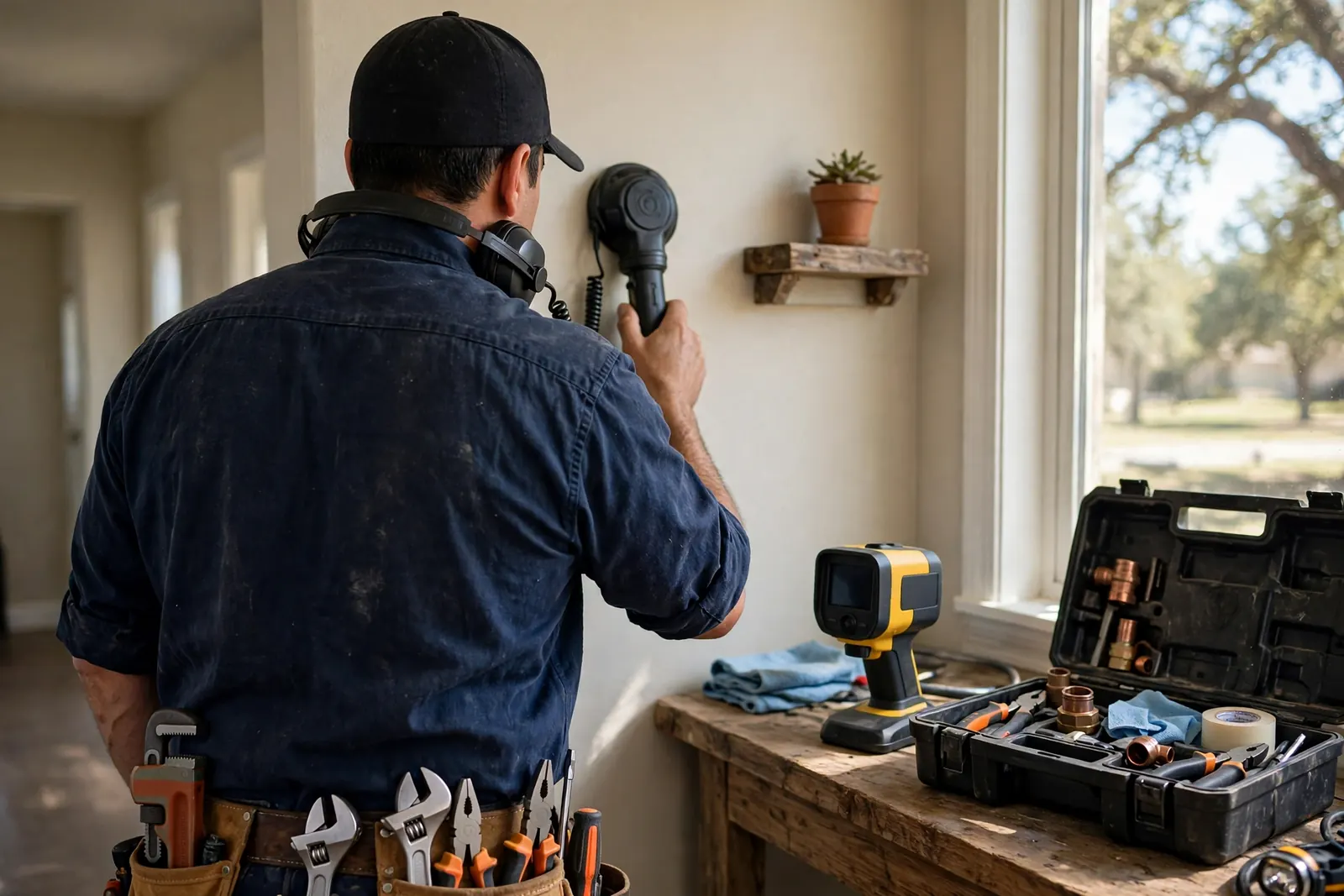
Picks up the sound of water escaping a buried or in-wall line. It is how we find a slab leak without breaking up the whole floor.
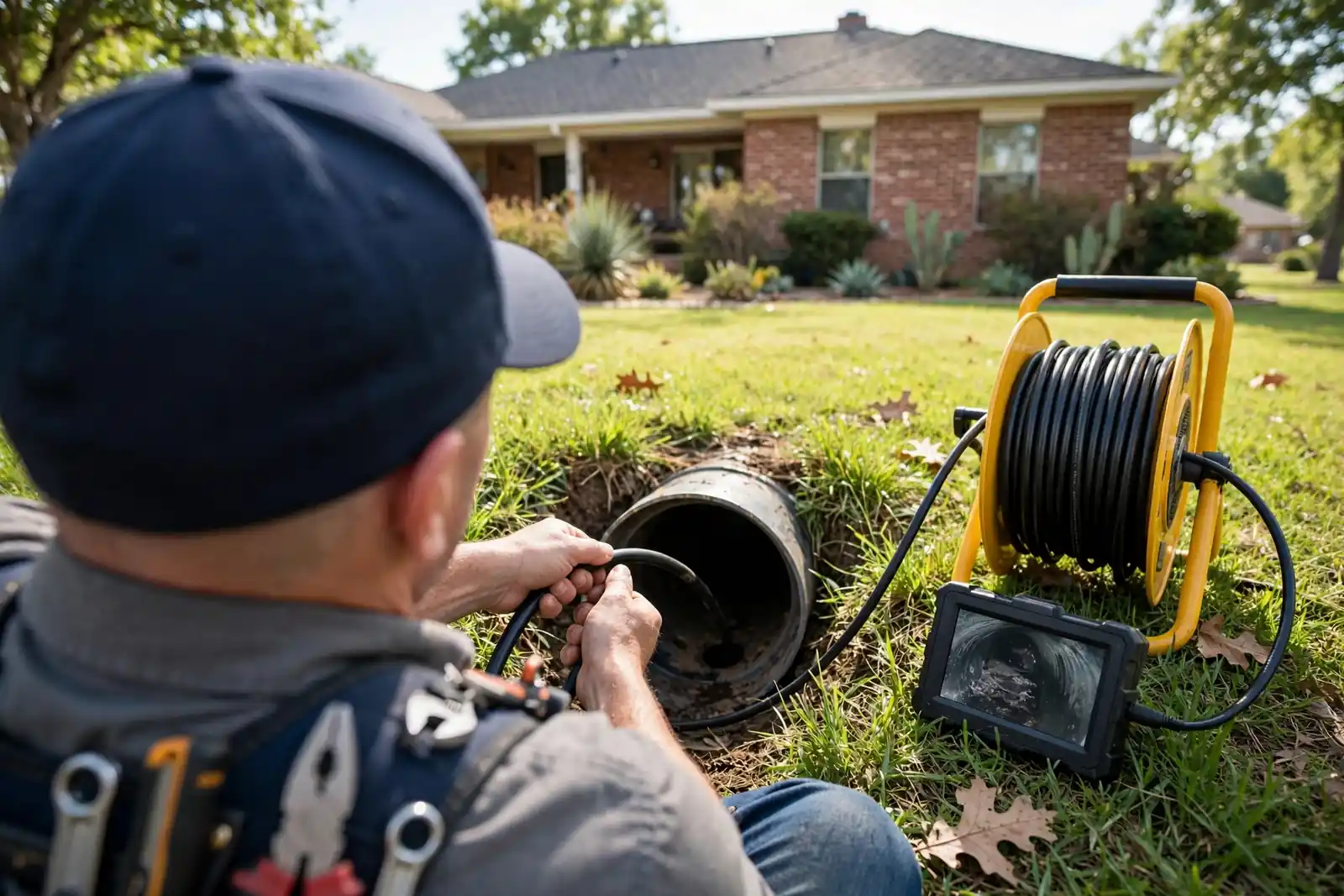
Lets us see inside a drain line to confirm whether a backup is a clog or a broken pipe. On sewer repairs, it shows the exact break location.
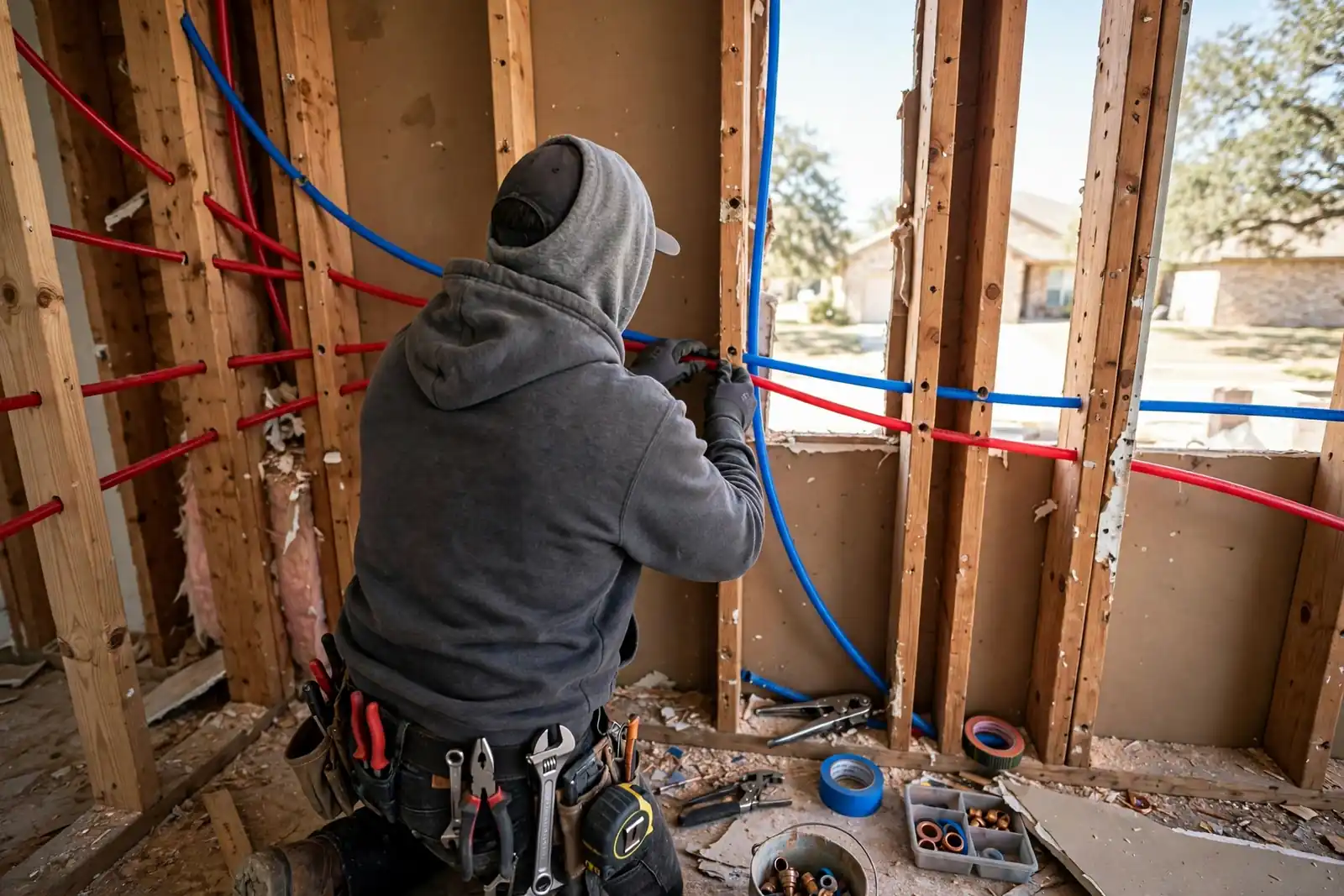
Makes the crimp connections on PEX tubing. PEX is what we run for most new supply lines because it handles freeze cycles better than copper.
Used for copper repairs where the existing line is copper. A properly soldered joint is still the most reliable connection in a copper system.
Gives a square cut on copper and PVC so the new fitting seats correctly. A crooked cut is the most common cause of a joint that weeps.
Thermal views are illustrative, generated from photographs of pipe repair work in Mount Pleasant, TX.
Confirms the line holds pressure after the repair. We watch the gauge before closing anything up.
Push-to-connect fittings used for fast repairs where soldering is not practical, like a tight crawlspace or a line that cannot be fully drained.
After every repair, we bring the line to full pressure and watch the gauge. A joint that holds at full pressure is a joint we will stand behind. If it weeps, we redo it before we leave.
Copper gets soldered copper, PEX gets crimped PEX, PVC gets solvent-welded PVC. Mixing materials without the right transition fitting is how repairs fail early. We match the existing system or use the correct adapter.
We locate the failure before we open anything. On a slab leak, that means one small opening instead of exploratory demolition. On an in-wall leak, it means one patch instead of a torn-up hallway.
Repairs follow the 2024 International Plumbing Code adopted by the City of Mount Pleasant (Ordinance 2026-2, effective 20 January 2026) as adopted in Texas. That covers pipe sizing, support spacing, and the fittings allowed on potable water lines. We pull permits when the job requires one.
A pipe bursts in the attic during a January freeze and water starts running down the ceiling.
We shut the water off at the main, cut out the split section, and spliced in new PEX or copper. The line was pressure-tested before anything was closed back in, and we checked the other attic runs for freeze risk.
Outcome: Water back on, with the failed section replaced and the freeze-prone lines flagged.
The water bill doubles and there is a warm spot on the hallway floor with no visible leak.
We used acoustic listening gear and a pressure gauge to locate the slab leak, then cut one targeted opening and repaired the line. The concrete was patched and the line tested at full pressure.
Outcome: The leak fixed with one small floor patch instead of a full slab break-up, and the bill back to normal.
A supply line under the kitchen sink starts dripping and the cabinet floor is getting soft.
We replaced the failed supply line and checked the shutoff valve and the trap while we were under there. If the valve will not close, we flag it so the next repair is not a flood.
Outcome: A dry cabinet, a working shutoff, and a repair that holds at pressure before we leave.
A rental property has a leaking pipe in the wall and the tenant needs water back on.
We coordinated access with the tenant, located the leak, opened the wall only where needed, and repaired the line. The repair was documented with photos for the property file.
Outcome: Water restored, with a photo record the owner can keep for the file.
Mount Pleasant, TX sits on East Texas clay, and the local conditions shape what fails and when. Slab-on-grade is the norm for newer homes, so a leak under the slab is the call we get most; older pier-and-beam homes fail differently, with lines shifting in saturated soil and joints working loose.
Winter is the busy season. A hard freeze splits uninsulated copper in attics and crawlspaces, and the leak often shows only at thaw. Summer brings the opposite problem: dry soil shifts and old lines crack at the joints. We put together a short guide on how to prevent frozen pipes in a Mount Pleasant, TX winter.
Example — a typical call. The stories below are illustrative examples of the kind of pipe repair calls we take, not a record of a specific past job.
Before: The homeowner had a warm spot on the hallway floor and a water bill that had jumped. The leak was a cracked copper line under the slab, close to where the floor felt warm.
After: We cut one small opening in the concrete, repaired the copper line, pressure-tested it at full pressure, and patched the slab. The bill dropped back to normal the next cycle.
We marked the repair location on a photo for the homeowner's records. Checking the water bill monthly is the fastest way to catch the next hidden leak early.
Before: A pipe in an uninsulated attic run split during a hard freeze and started running down the ceiling when it thawed. The homeowner shut off the main and called early in the morning. Water had already stained part of the ceiling.
After: We cut out the split section and spliced in PEX, pressure-tested the line, and had water back on before we left. The ceiling stain dried without needing replacement. We flagged two other attic runs that were not insulated.
Insulating the attic runs and keeping the attic hatch closed during freezes prevents a repeat. We quoted the insulation work separately.
Before: A 1950s home had rusty water at the kitchen faucet and pressure that had dropped to a trickle. The galvanized supply line had corroded until only a narrow channel was left. A spot repair would have failed within months.
After: We replaced the failing run with new PEX and added new shutoff valves at the kitchen and bathroom fixtures. Pressure at the kitchen faucet came back strong.
We noted the remaining galvanized sections for the homeowner. Replacing them on a planned schedule beats an emergency call later.
Most pipe failures start small and give you a warning. These are the ones we see most in Mount Pleasant, and what happens if they get ignored.
A repair that holds pressure the first time, documented before it is covered.
A pinhole leak can push water into a wall for days before anyone notices. Catching it early usually means a patch and paint instead of drywall, insulation, and baseboard replacement. We repair the line and dry-test the joint before closing anything up.
Under-slab leaks in Mount Pleasant soften the soil under a footing and show up later as cracks in brick and sticking doors. A slab leak located with acoustic listening gear and repaired before the soil moves further keeps the repair small. We map the line before we cut concrete.
A running toilet is obvious; a buried leak is not. A buried leak keeps adding to every bill until the line is fixed.
Frozen pipes in a January cold snap and corroded galvanized lines both fail without warning. Replacing a weak section on your schedule beats a burst-pipe call at 2 a.m. with water running down the hallway. We can inspect and shore up the weak spots first.
Clear records from your pipe repair job that you can keep and share.
Repair documented before it is covered
Pressure reading noted at completion
Pipe and fittings used on the job
Other weak sections flagged for watching
The right call depends on how much of the line is failing, not on how old the house is.
One isolated failure in an otherwise sound line
A run with several failures in a short span
A line failing along its length
A list like this tells people straight away whether we cover their street for pipe repair. Not listed? Call and ask — it only takes a minute.
Based in Mount Pleasant and covering the places around it. Pick one for local details.
It depends on access and material — a supply line under a sink is a different job from a slab leak that needs concrete cutting. We look at the line first and give you the number before work starts. Call (903) 350-9085 and describe what you see.
Shut off the main valve, then open a low faucet to drain the line. Do not try to patch a burst pipe with tape or epoxy — it will fail again under pressure. Call us and we will talk you through the shutoff and get a tech out.
Yes, in most cases. A pinhole leak, a cracked fitting or a failed joint can be cut out and repaired without touching the rest of the run. What we will not do is patch a line that is corroded through in several places — if the pipe is failing along its length, a spot repair just moves the next leak down the wall, and we will tell you that straight.
Three things dominate here: freezing nights in January and February, soil movement in East Texas clay, and corrosion in older galvanised and cast-iron lines. A hard freeze in an uninsulated attic or crawlspace splits copper in hours. Corrosion thins a pipe wall over decades until normal pressure finishes it. We can inspect and tell you which risk your house carries.
Other services from the same team.
Call (903) 350-9085 and describe what you are seeing. We will tell you how to shut the water down and what the repair involves. Open 24 hours, Monday–Sunday.
Call (903) 350-9085 any time — NTP Plumbing is open 24 hours, Monday–Sunday. Tell us what you are seeing and we will talk you through shutting the water off if you need to. We serve Mount Pleasant, TX, including ZIP codes 75455 and 75456.