Tankless vs tank water heaters for Mount Pleasant homes
Tankless vs tank water heaters each suit different Mount Pleasant, TX homes. This is an informational comparison — how they work, where each one fits, and what to weigh before you decide.
Summary: There is no single right answer to the tankless-versus-tank question: it depends on household size, bathrooms, space, fuel, and how the home uses hot water. This guide lays out the comparison so a Mount Pleasant, TX homeowner can weigh it with real information. Replacing a water heater requires a City permit either way.
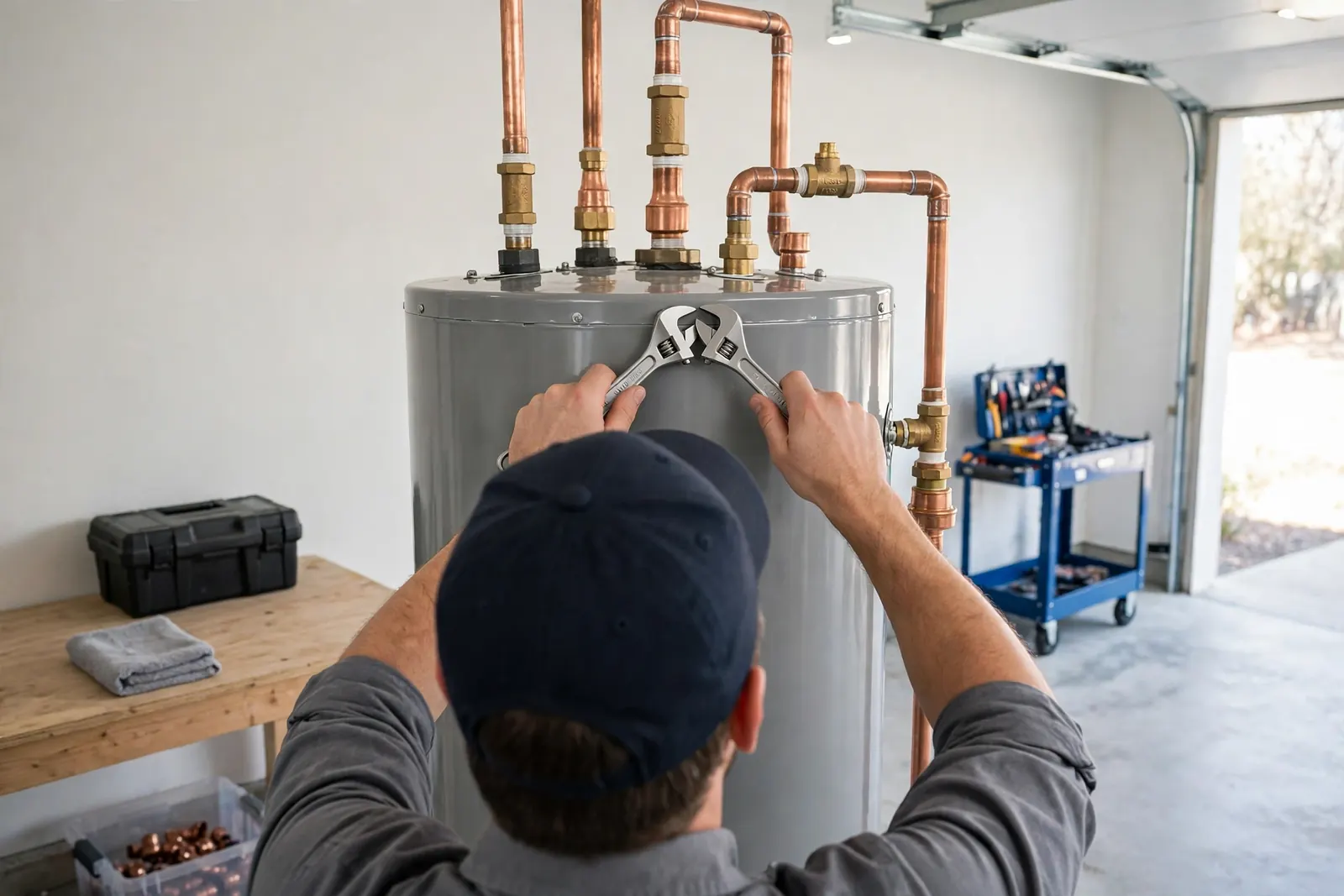
There is no single right answer to the tankless-versus-tank question. The right choice depends on the size of the household, the number of bathrooms, the space available, the fuel available at the house, and how the home uses hot water. This guide lays out the comparison so a Mount Pleasant, TX homeowner can weigh it with real information.
One note before the details: replacing a water heater in Mount Pleasant, TX is plumbing work that requires a permit from the City of Mount Pleasant, TX, and the work follows the 2024 International Plumbing Code adopted under Ordinance 2026-2, effective 20 January 2026. That applies to tank and tankless replacements alike.
Tankless vs tank water heaters: how a tank water heater works
A tank heater keeps 40 or 50 gallons of water hot around the clock. When you open a tap, hot water leaves the top of the tank and cold water enters the bottom to be heated. It is simple, proven, and easy to service. The trade-off is standby loss — energy spent keeping water hot when nobody is using it — and a fixed supply: once the tank is empty, the next shower waits for the tank to recover.
Tank heaters suit smaller households, homes with one or two bathrooms, and any home where the existing tank, venting, and gas or electric supply are already in place. A like-for-like tank swap is the least disruptive replacement there is.
How a tankless water heater works
A tankless unit heats water only when a tap opens. There is no stored hot water, so there is no standby loss and no tank to run dry — the supply is continuous as long as the unit can keep up with the flow rate. The trade-offs are different: the unit needs enough capacity for the home's peak simultaneous demand, it needs the right gas supply or electrical capacity, and it needs venting designed for a tankless unit.
Tankless suits larger households, homes with three or more bathrooms, and homes where several people shower in sequence. It also suits homes where floor space matters — a tankless unit mounts on a wall and frees the space a tank would occupy. Some lakefront homes around Mount Pleasant, TX use two tankless units to serve a large house with distant bathrooms, which shows how the sizing decision scales with the home.
Hot-water supply and peak demand
This is the decision that matters most. Add up what runs at once on a busy morning: two showers, a dishwasher, a washing machine. A tank heater handles that until the tank empties, then it needs recovery time. A tankless unit handles it only if its flow capacity covers the combined demand — and in winter, when incoming water is colder, the same unit delivers less hot water per minute than in summer.
A home with a soaking tub is the clearest example. Filling a large tub plus running a shower can outrun a single standard tank, and it can also outrun an undersized tankless unit. The answer in both cases is sizing the system to the home's actual peak use, not to the average. A recirculation loop is a separate question: it shortens the wait for hot water at a distant bathroom, which matters in larger homes where the heater sits far from the taps.
Space, venting, and fuel
A tank needs floor space, a drain pan where a leak would cause damage, and clear access — in an attic, the City's rules require a passageway at least 30 inches high by 22 inches wide, solid flooring, and a level service space. A tankless unit needs wall space, proper venting, and an adequate gas line or electrical supply. Switching fuels or upsizing a gas line is part of the job, not an afterthought, and gas work follows the 2024 International Fuel Gas Code as adopted by the City of Mount Pleasant, TX.
Fuel matters too. Some properties outside the city limits use propane rather than natural gas, and the heater choice has to match the fuel that is actually available at the address. Verify the fuel, the venting route, and the available space before choosing a type — the wrong combination is the most common source of disappointment after a water heater change.
Upkeep and lifespan
Both types need maintenance. A tank heater needs periodic flushing to remove sediment, and its anode rod needs checking and replacing on schedule — that rod is what keeps the steel tank from corroding. A tankless unit needs periodic descaling. How often descaling is needed depends on your water test: with harder water, about once a year; with softer water, every couple of years. No published hardness figure exists for Mount Pleasant, TX water, so we test your water first rather than quoting a number.
On lifespan, a tank heater typically serves around a decade, sometimes more with steady maintenance; a tankless unit typically serves longer, but only with its maintenance kept up. The longer life of a tankless unit has to be weighed against its higher upfront installation cost — the unit, the venting, and any gas or electrical upgrades.
Which fits which Mount Pleasant, TX home
As a rough guide: a one- or two-bathroom home with a straightforward replacement is usually well served by a tank. A three-plus-bathroom home, a household with back-to-back showers, a home with a soaking tub, or a new build where the plumbing is being designed from scratch is where tankless earns its keep. New-build neighbourhoods such as Stone Briar and Northwood — with their large primary suites, soaking tubs, and separate showers — are the homes where the tankless question comes up most often, because the hot-water demand is built into the floor plan.
Either way, the deciding step is a proper sizing conversation about the home's real peak demand, not a brochure comparison. Our water heater installation service in Mount Pleasant, TX and water heater repair service in Mount Pleasant, TX cover both tank and tankless systems, and our guide to when to schedule water heater maintenance in Mount Pleasant, TX covers the upkeep for whichever type you have.
Get help with plumbing in Mount Pleasant, TX
Tank or tankless is a sizing decision, not a brand decision. Work out your peak demand, check the fuel and venting, and choose from there. Call NTP Plumbing at (903) 350-9085 — open 24 hours, Monday–Sunday.