Why does my drain keep clogging after cleaning in Mount Pleasant, TX
A drain that clogs again days after cleaning usually has a deeper problem than a simple blockage. Here is why it keeps happening in Mount Pleasant, TX homes, and how to stop the cycle.
Summary: Clearing a drain and watching it clog again a week later is a sign the first cleaning only dealt with part of the problem: a plunger or hand auger can punch a hole through a clog without removing it. If the same drain keeps slowing down, something structural is usually going on underneath. Here are the causes we actually find, in the order we check them.
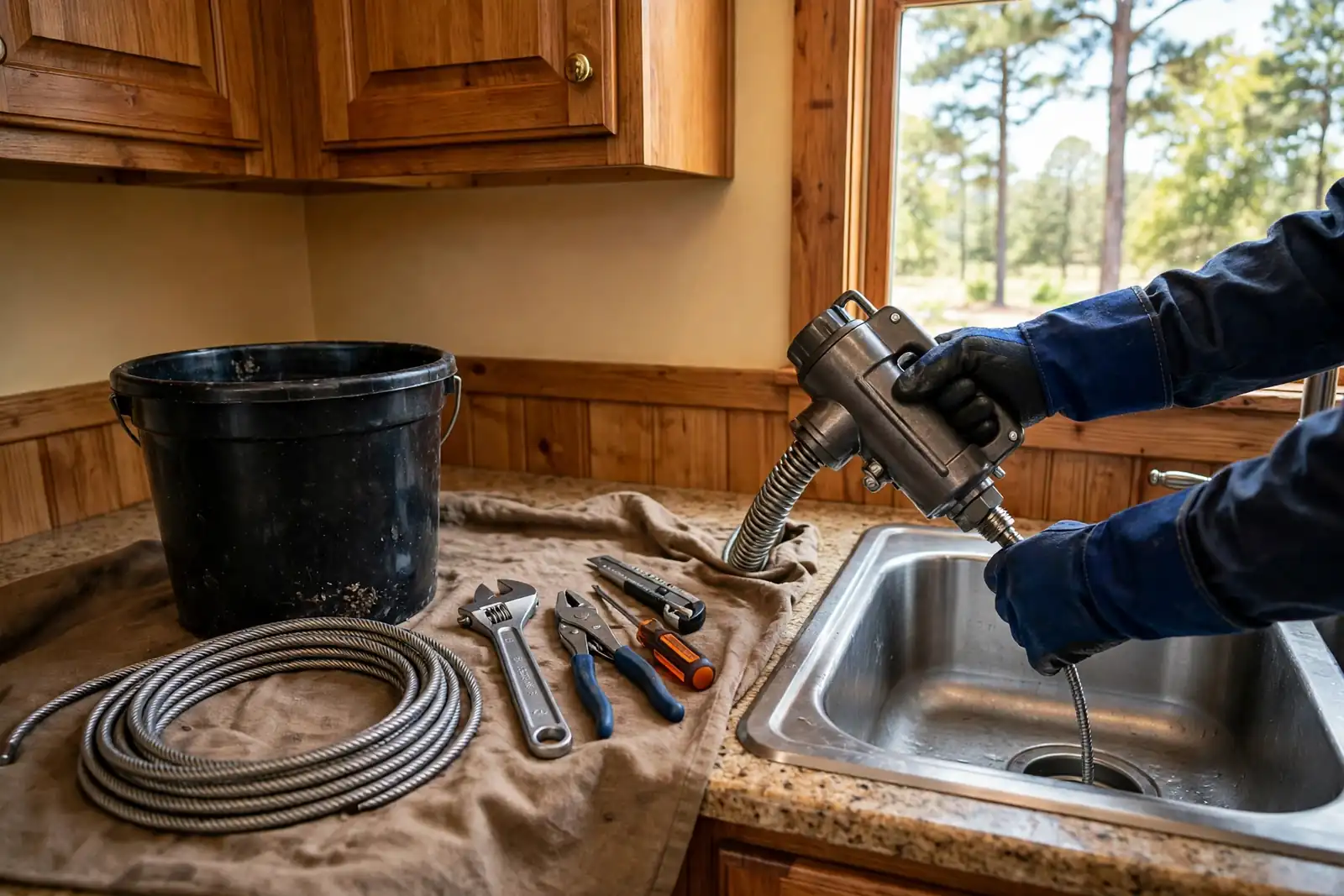
Clearing a drain and watching it clog again a week later is frustrating — and it is a sign the first cleaning only dealt with part of the problem. A plunger or a hand auger can punch a hole through a clog without removing it, and the remaining material catches everything that follows. If the same drain keeps slowing down, something structural is usually going on underneath.
We are NTP Plumbing, and repeat clogs are one of the most common calls we take across Mount Pleasant, TX. Here are the causes we actually find, in the order we check them.
Why your drain keeps clogging after cleaning: the cleaning only cleared part of the clog
The most common reason a drain reclogs is that the first attempt never removed the blockage. A plunger moves water, not material. A short hand auger reaches a few feet and bores a narrow channel through grease or hair, which then closes up again as soon as more waste passes through. Chemical drain cleaners are worse: they can soften the surface of a clog while leaving the core intact, and they do nothing for a physical obstruction.
A proper drain cleaning in Mount Pleasant, TX clears the full diameter of the pipe. If your drain was cleared with a plunger or a store-bought snake and it slowed down again within days, the clog was almost certainly only partly removed.
Grease buildup in kitchen lines
Kitchen drains in Mount Pleasant, TX fail on grease more than anything else. Cooking oil, butter, and food fats go down the drain as liquid, cool in the pipe, and coat the walls. Each layer narrows the pipe a little more, and the rough surface catches food particles until water barely passes. Hot water and dish soap do not dissolve a grease lining once it has set — they just move the problem further down the line.
Grease is also the reason a kitchen sink can drain fine for months and then suddenly back up. The buildup is gradual until the last bit of clearance disappears. Scraping plates into the trash, wiping pans before washing, and never pouring oil down the drain are the only reliable prevention. If the line is already lined with grease, it needs a full cleaning, not another bottle of drain cleaner.
Tree roots in older sewer lines
If every drain in the house is slow, or the lowest fixtures back up first, the problem is usually in the main sewer line — and in Mount Pleasant, TX that often means roots. More than half of homes in town were built before 1980, and many still have cast-iron drain lines. Cast iron develops horizontal cracks as East Texas clay soil swells and shrinks around it, and roots find those cracks fast. Once inside, roots grow into a mat that catches paper and waste.
Root intrusion does not go away with a standard cleaning. The roots grow back, usually within months. The fix starts with a camera inspection so the exact location and condition of the line is known — then the line can be repaired or replaced based on what the camera shows. Our sewer line repair service in Mount Pleasant, TX starts with that inspection, because guessing at a root problem wastes everyone's time.
A bellied or broken pipe under the house
Clay soil movement does more than crack cast iron. It can shift a pipe so a section sags — a "belly" — where water pools instead of flowing. Waste settles in the sag, the line clogs repeatedly in the same spot, and no amount of cleaning changes the shape of the pipe. A collapsed section behaves the same way, except the blockage is permanent.
This is the pattern to suspect when the same drain clogs in the same place every few weeks, cleaning helps briefly, and the rest of the house drains normally. Only a camera shows a belly or a break. Homes on slab foundations — the norm for newer homes in Mount Pleasant, TX — hide these problems under concrete, which is why locating the fault precisely before any floor is opened matters so much.
The wrong things going down the drain
Some repeat clogs are a household habit, not a pipe defect. The usual suspects:
- Kitchen: grease, coffee grounds, rice and pasta that swell, fibrous food like celery and onion skins.
- Bathroom: hair, soap scum, and "flushable" wipes — which do not break down the way toilet paper does.
- Toilets: wipes, cotton products, dental floss, and too much paper at once.
- Laundry: lint and detergent residue in a shared drain, especially where the washer drains into a kitchen or bathroom line.
If the clog always follows the same fixture, start with what goes into that fixture. A garbage disposal that is jammed or draining slowly in Mount Pleasant, TX can also send food waste into the line in chunks instead of grinding it, which clogs the branch line downstream.
Old pipe material reaching the end of its life
Pipe material is an age story in Mount Pleasant, TX. Homes built in the 1940s through the 1960s commonly have galvanised steel supply lines and cast-iron drains; polybutylene supply systems appeared through the 1980s and 1990s. Corroded galvanised pipe narrows from the inside until flow is a trickle, and cast iron scales and cracks. A drain that keeps clogging in a house from this era may not have a clog at all — it may have a pipe that has lost most of its internal diameter.
That is a different job from cleaning, and it is worth knowing before paying for a third or fourth cleaning. A camera inspection plus a look at the home's build year gives a straight answer. Our pipe repair service in Mount Pleasant, TX covers the point where cleaning stops helping and the pipe itself needs attention. Older streets such as Southgate, where the brick ranches date to 1974–1980, and the in-town grid around downtown Mount Pleasant, TX are where we see this most.
What a camera inspection actually shows
A camera inspection is the step that turns guessing into a plan. The camera travels the line and shows grease lining, root mats, bellies, breaks, and scale — plus the exact distance from the clean-out, so any repair is dug in the right place. It also shows whether the line is in good shape and the problem is simply usage, which is the answer nobody minds hearing.
Ask for the recording or the still images. A reputable visit leaves you with something you can keep, and it is the basis for deciding between another cleaning, a spot repair, or a sewer line replacement in Mount Pleasant, TX if the line is beyond repair.
Get help with plumbing in Mount Pleasant, TX
If the same drain has clogged three times, stop clearing it and find out why. A camera inspection costs less than a fourth cleaning that does not hold. Call NTP Plumbing at (903) 350-9085 — open 24 hours, Monday–Sunday.